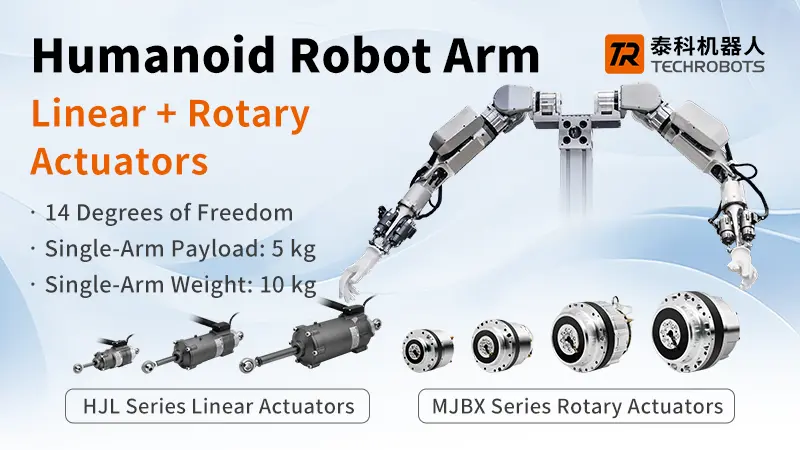
Embodied Intelligence Core Actuator: Core Technology and Engineering Deployment of Humanoid Robot Joint Actuators
Date:2026-03-09As embodied intelligence (Embodied AI) technology advances rapidly, humanoid robots are transitioning quickly from laboratory prototypes to real-world industrial production, domestic services, and commercial operations. The humanoid robot joint actuator (also known as an integrated actuator) serves as the core execution unit bridging AI algorithms and the physical world. It is the decisive hardware determining dynamic response, payload-to-weight ratio, control precision, and scene adaptability. Its level of integration, power density, and environmental compatibility directly sets the upper limit on the robot’s degrees of freedom layout and overall motion performance ceiling.
Mainstream global humanoid robots currently adopt a highly integrated electromechanical solution for rotary joint actuators: “permanent-magnet synchronous frameless torque motor + high-precision harmonic reducer + servo driver + dual absolute encoders (high-speed + low-speed end)”. Unlike the steady-state operation of fixed-base industrial robots, humanoid robots operate in complex floating-base, wide-range variable-load, and human-robot coexisting environments. Therefore, Techrobots imposes far stricter technical requirements on joint actuators than those for traditional industrial actuators.
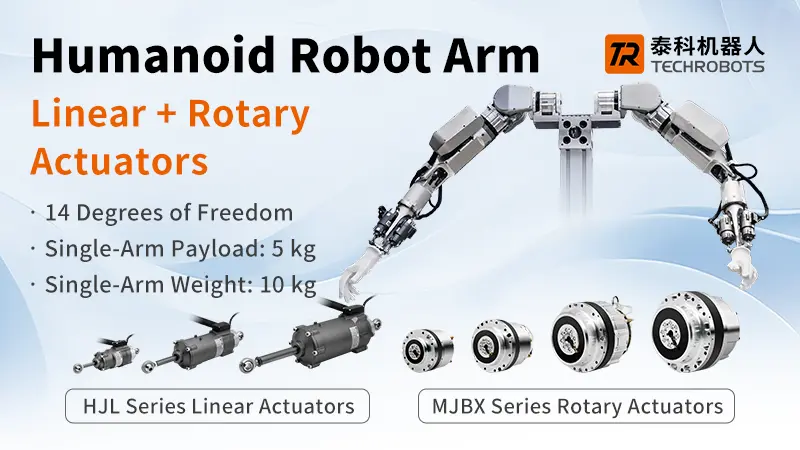
1. High Power Density Integrated Design: The Core Performance Foundation of Humanoid Robot Joint Actuators
Power density and torque density are the primary evaluation metrics for humanoid robot joint actuators. The industry uses four key dimensions: volumetric power density (W/L), gravimetric power density (W/kg), volumetric torque density (Nm/L), and gravimetric torque density (Nm/kg). For the low-speed, high-torque quasi-direct-drive characteristics of humanoid joints, torque density is the most scenario-relevant core metric.
1.1 Biomimetic Constraints and Lightweight Design Requirements
The biomimetic structure of humanoid robots imposes unbreakable physical size and weight limits on joint actuators, creating three core design constraints:
• Hard dimensional boundaries: A humanoid typically has 20–40 DoF, each requiring a joint actuator sized to match human proportions. Leg/waist high-load joints are limited to ≤110 mm (engineering limit ≤120 mm) outer diameter; elbow/shoulder mid-load joints are controlled at 70–90 mm; wrist joints ≤60 mm flange diameter; micro finger joints ≤20 mm. Actuators use axially stacked “hamburger” integration to maximize space for transmission, cabling, and assembly.
• Mandatory hollow structure: High/mid-load joints require central through-holes for cable routing to prevent fatigue, further compressing effective design space.
• Lightweight core constraint: Lower actuator weight improves battery endurance, reduces joint inertia, enhances dynamic response, and increases human-robot interaction safety. High-torque-density motor design, combined with high-strength aluminum alloy housings and topology-optimized structures, is the key to actuators lightweighting.
1.2 Industry-Standard High-Dynamic Overload Capability
In jumping, squatting, or heavy-load scenarios, joint actuators must handle instantaneous high-impact loads. Industry requirements include:
• 2–3× rated torque short-term overload capacity, stable for 200–500 ms to cover gait impacts and dynamic actions.
• Motor peak torque must satisfy: Tₘₒₜₒᵣ_ₚₑₐₖ × i × η ≥ Tₒᵤₜ_ₚₑₐₖ (where i is the harmonic reducer ratio >1, and η ≈60–75% under peak torque). Motors typically need 3–4× rated torque.
• Overload duration is limited by winding thermal time constants; 2.5× rated overload ≤500 ms per occurrence (cumulative ≤5% per cycle); 3× and above limited to ≤300 ms with thermal simulation verification to prevent damage.
1.3 Engineering Solutions for Power Density Enhancement
The industry achieves breakthroughs through core component optimization and actuators integration:
• Motor electromagnetic optimization via multi-physics simulation for low-speed/high-torque conditions, reducing losses and improving energy conversion efficiency.
• Integrated lightweight design: Rotor-wave-generator and stator-housing co-machining, elimination of redundant connectors, and lightweight materials to minimize weight, axial length, and inertia.
2. Full-Chain Thermal Management: The Safety Red Line for Long-Term Reliable Operation
Temperature rise control and full-chain thermal management are the primary bottlenecks limiting continuous operation and reliability of humanoid joint actuators, representing the key mass-production threshold. Unlike fixed-base industrial motors, humanoid joints float without a stable heat sink, making active cooling impractical. Most actuators rely solely on natural convection and conduction.
2.1 Multi-Heat-Source Coupling Characteristics
Heat sources include: motor Joule losses (especially severe during stall), servo driver switching/ conduction losses, and mechanical friction losses in the harmonic reducer and bearings.
2.2 Cascading Failure Risks from Over-Temperature
Excessive temperature rise leads to:
• Halved insulation life per 10°C rise (Arrhenius law, IEC 60034-1).
• Irreversible demagnetization of NdFeB magnets (≤5% flux loss required).
• Doubled electronic component failure rate per 10°C rise.
• Degraded lubrication, wear, thermal expansion, and encoder drift, reducing precision.
2.3 Full-Chain Thermal Management Solutions
• Loss suppression at source (low-loss cores, GaN devices, low-friction grease).
• Enhanced heat paths (high-thermal-conductivity epoxy potting, interface materials, phase-change materials for hotspots).
• Current-density and thermal-field co-management with multi-physics simulation verification.
3. Full-Cycle Torque Smoothness Control: Core Key to High-Precision Human-Robot Coexistence
Torque smoothness is the defining differentiator from industrial actuators, directly governing motion fluidity, force-control precision, and interaction safety. Fluctuations arise from motor cogging torque, reducer transmission error, and stiffness variation.
3.1 Industry-Standard Torque Ripple Requirements
• General humanoid scenarios: ≤3% peak-to-peak under rated load; motor cogging ≤1%.
• Ultra-precision medical/assembly scenarios: ≤1% peak-to-peak; motor cogging ≤0.5%.
3.2 Full-Chain Optimization Solutions
• Electromagnetic source suppression (fractional-slot concentrated windings, arc magnets, skew poles).
• Transmission chain precision (optimized tooth profile, zero-backlash design, coaxial assembly control).
• Closed-loop compensation (dual-encoder feedback + high-bandwidth current loop + torque feedforward).
4. Electromechanical Co-Optimization: The Core Logic from Prototype to Mass Production
The three performance metrics have inherent trade-offs. Top-tier designs shift from component-level optimization to full “motor–reducer–driver–sensor” co-optimization via multi-physics (electromagnetic–thermal–magnetic) simulation.
4.1 Inherent Trade-Off Relationships
• Power density vs. temperature rise
• Low torque ripple vs. high torque output
• High power density vs. low inertia
• Performance vs. cost
4.2 Industry Frontier Mass-Production Directions
• Ultimate integration (stator–driver co-integration, rotor–encoder integration).
• Mature new technologies (quasi-direct-drive QDD, planetary roller screw linear actuators, series elastic actuators SEA).
• Intelligent perception fusion (integrated multi-dimensional sensors for real-time state awareness and closed-loop control).
Summary
Humanoid robot joint actuators are the foundational hardware for embodied intelligence commercialization. They integrate electromagnetic design, mechanical transmission, servo control, thermal management, and precision manufacturing into a high-end electromechanical module. High power density is the cornerstone of dynamic performance, full-chain thermal management is the safety red line for long-term reliability, and full-cycle torque smoothness is the key to high-precision human-robot coexistence.
As the humanoid robot industry accelerates, Techrobots’ joint actuator mass-production solutions will continue iterating toward higher integration, higher power density, higher reliability, and lower cost, serving as the core technology engine driving humanoid robots from laboratories to large-scale deployment across industries.